
How to Open a Demat Account in India in 2026 (Step-by-Step for Beginners)
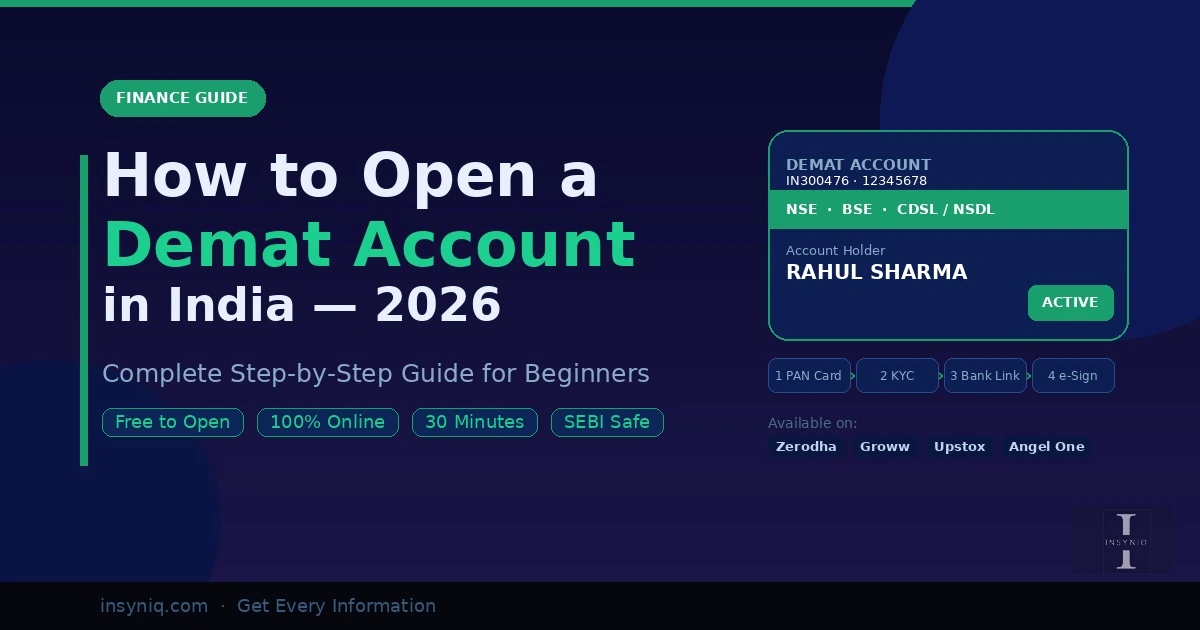
If you’ve ever wanted to invest in stocks, mutual funds, or IPOs in India, the first thing you need is a Demat account. But if you’re a beginner, the process can feel confusing too many terms, too many broker options, and nobody explaining it simply.
This guide breaks it all down. By the end of this post, you’ll know exactly what a Demat account is, which broker to choose, what documents you need, and how to open your account online in under 30 minutes completely free.
What Is a Demat Account?
A Demat account short for Dematerialised account is a digital account that holds your shares and securities electronically. Think of it like a bank account, but instead of money, it stores your stocks, bonds, ETFs, and mutual fund units.
Before Demat accounts existed in India, shares were held as physical paper certificates. Today, everything is digital. When you buy shares of a company like Tata Motors or Infosys, those shares get stored in your Demat account automatically.
You cannot buy or sell shares on the NSE or BSE without a Demat account. It is mandatory.
Demat Account vs Trading Account vs Bank Account – What’s the Difference?
This confuses most beginners, so let’s clear it up simply:
Bank Account: holds your money (rupees). You already have this.
Trading Account: the account you use to place buy and sell orders on the stock exchange. It’s the platform where transactions happen.
Demat Account: stores the shares you’ve bought. After you buy shares through your trading account, they sit safely in your Demat account.
When you open an account with a broker like Zerodha or Groww, they open all three for you at the same time. You don’t have to do it separately.
Who Can Open a Demat Account in India?
You can open a Demat account if you are:
- An Indian resident above 18 years of age
- An NRI (Non-Resident Indian) to separate NRI Demat account
- A minor, through a guardian-operated account
You do not need a job or a minimum income. A student, housewife, or retired person can open one just as easily.
Documents Required to Open a Demat Account
Before you start, keep these documents ready. All of them are uploaded digitally no physical paperwork needed:
Identity Proof (any one):
- Aadhaar Card
- PAN Card
- Passport
- Voter ID
Address Proof (any one):
- Aadhaar Card (accepted as both identity and address proof)
- Passport
- Driving Licence
- Utility bill (electricity or water not older than 3 months)
Other mandatory documents:
- PAN Card: absolutely required, no exceptions
- Bank account details: your account number and IFSC code
- A cancelled cheque or bank statement
- Passport-size photograph
Important: Your PAN card and Aadhaar card must be linked. If they are not linked, you cannot complete KYC. You can check and link them on the Income Tax portal (incometax.gov.in) for free.
Which Broker Should You Choose in 2026?
There are two types of brokers in India:
Discount brokers charge zero or very low fees. Best for beginners and active traders. Examples: Zerodha, Groww, Upstox, Angel One.
Full-service brokers offer research, advisory, and personal support but charge higher fees. Examples: ICICI Direct, HDFC Securities, Kotak Securities.
For a beginner in 2026, a discount broker is the right choice. Here’s a quick comparison of the most popular ones:
| Broker | Account Opening Fee | Annual Maintenance | Brokerage on Delivery |
|---|---|---|---|
| Zerodha | Free | ₹300/year | Zero |
| Groww | Free | Free | Zero |
| Upstox | Free | Free | Zero |
| Angel One | Free | Free | Zero |
| ICICI Direct | Free | ₹700/year | 0.55% per trade |
Recommendation for beginners: Start with Groww or Zerodha. Both are SEBI-registered, beginner-friendly, and have excellent mobile apps. Groww is slightly simpler for absolute beginners. Zerodha (Kite) is better if you plan to do active trading later.
How to Open a Demat Account Online Step by Step
We’ll use Groww as the example since it’s the easiest for beginners, but the process is nearly identical for all brokers.
Step 1: Download the App or Visit the Website
Go to groww.in or download the Groww app from Google Play Store or App Store. Click on “Sign Up” and enter your mobile number and email address.
Step 2: Enter Your PAN Card Details
Enter your PAN card number. Groww will verify it automatically with the Income Tax database. This takes about 10 seconds.
Step 3: Complete Your KYC (Know Your Customer)
KYC is the government-mandated identity verification process. You’ll need to:
- Enter your Aadhaar number
- Complete Aadhaar-based e-KYC — a one-time password (OTP) will be sent to your Aadhaar-linked mobile number
- Upload a photo of your PAN card
- Take a live selfie (the app guides you through this)
If your mobile number is not linked to Aadhaar, you’ll need to visit a nearby DigiLocker-enabled centre or complete offline KYC.
Step 4: Enter Your Bank Account Details
Enter your bank account number and IFSC code. You can find the IFSC code on your cheque book or bank passbook. Groww will send a small verification amount (₹1) to confirm it’s your account.
Step 5: E-Sign Using Aadhaar OTP
The final step is e-signing your application using your Aadhaar OTP. This is your digital signature and makes the application legally valid. You’ll receive an OTP on your Aadhaar-linked mobile number enter it and you’re done.
Step 6: Wait for Activation
Your Demat account will be activated within 24 to 48 hours on working days. You’ll receive your account number (also called DP ID) via email and SMS.
That’s it. Your Demat account is now open and ready to use.
What Is a DP ID and Client ID?
Once your account is activated, you’ll receive two numbers:
DP ID an 8-digit number that identifies your broker (Depository Participant). For example, Groww’s DP ID starts with IN300.
Client ID a unique 8-digit number that identifies your specific account.
Together, DP ID + Client ID = your full Demat account number (16 digits). You’ll need this when applying for IPOs or transferring shares between brokers.
CDSL vs NSDL — What’s the Difference?
India has two depositories that hold your shares in digital form:
CDSL (Central Depository Services Limited) used by brokers like Groww, Upstox, Angel One.
NSDL (National Securities Depository Limited) used by brokers like Zerodha, HDFC Securities.
Both are equally safe and regulated by SEBI. You don’t choose between them your broker chooses for you. It makes no practical difference to you as an investor.
How Much Does It Cost to Open and Maintain a Demat Account?
In 2026, most discount brokers offer:
- Account opening: Free
- Annual Maintenance Charge (AMC): Free or ₹300/year depending on broker
- Brokerage on buying/selling stocks (delivery): Zero with most discount brokers
- Brokerage on intraday trades: ₹20 per order flat (Zerodha, Upstox) or free (Groww)
The only costs you cannot avoid are government charges STT (Securities Transaction Tax), GST on brokerage, SEBI turnover fees, and stamp duty. These are very small amounts (fractions of a percent) and are charged automatically.
Is a Demat Account Safe?
Yes, completely. Here’s why:
- All brokers in India are registered with SEBI (Securities and Exchange Board of India)
- Your shares are held with CDSL or NSDL not with your broker. Even if your broker shuts down, your shares are safe
- Demat accounts have two-factor authentication (2FA) for all transactions
- You receive SMS and email alerts for every transaction
The only risk is market risk the value of your shares can go up or down. That’s the nature of investing, not a flaw in the Demat system.
Common Mistakes Beginners Make When Opening a Demat Account
Mistake 1: Opening with a bank instead of a discount broker Your bank (HDFC, SBI, ICICI) will offer to open a Demat account for you. Avoid this. Bank-linked Demat accounts usually charge much higher brokerage fees. Stick to dedicated discount brokers.
Mistake 2: Not linking PAN and Aadhaar first If your PAN and Aadhaar are not linked, your account will get stuck at the KYC stage. Check and link them before starting.
Mistake 3: Opening multiple accounts You don’t need more than one Demat account to start. Pick one broker, learn the platform, and expand later if needed.
Mistake 4: Investing before learning A Demat account is just a container. Having one doesn’t mean you should start buying stocks immediately. Spend at least 2–4 weeks learning about how the stock market works before putting any money in.
Mistake 5: Ignoring the nominee When opening your account, add a nominee (a family member). This ensures your investments are transferred to them in case of an emergency.
What Can You Do With a Demat Account?
Once your account is active, you can:
- Buy and sell shares of companies listed on NSE and BSE
- Invest in IPOs (Initial Public Offerings)
- Hold ETFs (Exchange Traded Funds)
- Invest in Government Bonds and Sovereign Gold Bonds
- Hold mutual fund units in statement of account form
- Participate in rights issues and bonus shares
Frequently Asked Questions
Q: Can I open a Demat account without a PAN card?
A: No. PAN card is mandatory for opening any Demat account in India. There are no exceptions.
Q: Can I have two Demat accounts?
A: Yes, you can have multiple Demat accounts with different brokers. There is no legal restriction. However, for beginners, one is enough.
Q: What happens to my shares if my broker shuts down?
A: Your shares are safe. They are held with CDSL or NSDL, not with your broker. You can transfer them to another broker using a DIS (Delivery Instruction Slip) or online transfer.
Q: Can I open a Demat account for free?
A: Yes. As of 2026, Groww, Upstox, Zerodha, and Angel One all offer free account opening with zero account opening charges.
Q: How long does it take to open a Demat account online?
A: The process takes 20–30 minutes online. Account activation takes 24–48 working hours after submission.
Q: Can a student open a Demat account?
A: Yes, as long as you are 18 years or older and have a PAN card and bank account.
Final Thoughts
Opening a Demat account in India in 2026 is easier than ever. The entire process is online, takes less than 30 minutes, and costs nothing with the right broker. The most important things to remember are: choose a SEBI-registered discount broker, have your PAN and Aadhaar linked before you start, and don’t rush into investing before you understand the basics.
If you’re just starting out, go with Groww or Zerodha both are trusted by millions of Indian investors and have apps that make the whole experience simple even if you’ve never invested before.
Once your account is open, start small even ₹500 per month through a SIP in a mutual fund is a great way to begin your investment journey.
Disclaimer: This article is for educational purposes only and does not constitute financial advice. Please do your own research or consult a SEBI-registered financial advisor before making investment decisions.